

Leadless Pacemaker Surgery as Major Surgery in the MDS Assessment
Updated: Aug 18

Question: Two weeks before being admitted to the SNF, the patient was in the ICU. Their heart rate was in the 30's. Procedure notes stated that a leadless pacemaker surgery for a Complete Heart Block was performed via the femoral access under general anesthesia and, after the procedure, the surgeon required the patient to stay in the ICU for a CXR and ECG stat and again in morning. Should this leadless pacemaker placement to be considered as a major surgery in the MDS assessment item J2100 according to the RAI manual?
Answer: Yes, it can. Based on the facts provided, this leadless pacemaker surgery via femoral access meets the RAI User's Manual definition of major surgery to be coded in the MDS assessment, assuming the hospitalization was an acute-care inpatient admission for at least one day. (Note: Pacemaker insertion via chest implantation is a different procedure: There is no chest incision or visible pacemaker pocket and it may also be considered a major surgery depending if the criteria defined in the RAI User's Manual applies.)
The current CMS RAI (Resident Assessment Instrument) User's Manual defines “major surgery” as a procedure where:
The resident was an inpatient in an acute-care hospital for at least 1 day, and
The surgery carried some degree of risk to the resident’s life or potential for severe disability. 1
Below is a screenshot of the RAI User's Manual citing the criteria of what is considered a "major surgery" specific to MDS item J2100.

Applying the "Major Surgery" RAI Criteria for Pacemaker Procedure in the MDS Assessment
In the scenario:
Complete heart block → Serious cardiac conduction problem.
Heart rate in the 30s → Significant bradycardia and clinically concerning.
Leadless pacemaker implanted → A cardiac procedure intended to treat the heart block.
Patient remained in the hospital overnight for an CXR and ECG the next morning → If the record confirms this was an acute-care inpatient admission, the ≥1-day inpatient criterion is met.
The procedure involves the heart and, in this clinical context, has an obvious potential for serious harm if the condition is not treated.→ Complications may occur related to the femoral vein access and risk for cardiac perforation and tears that result in death.3 "Major procedure-related complications were defined as those prolonging hospital stay, requiring a new admission, or resulting in significant disability (life-threatening or resulting in death through 30 days after implantation)."2
Procedure occurred 2 weeks before admission to SNF → If record confirms the procedure was done during the 30 days prior to admission, then the look-back period is met.
Therefore, this surgery would be considered as major surgery for MDS purposes, rather than treating it as a minor procedure simply because it was a leadless/percutaneous pacemaker procedure. The insertion from the femoral access is not one quick, straight direction to the heart. Some clinicians assisting with this leadless pacemaker procedure make sure they have eaten a meal before the start of the procedure as it can run up to 4 hours! But that's a tidbit besides the point! An important fact to remember: The RAI User's Manual specifically does not list general anesthesia as a requirement in the major surgery definition.
The RAI Manual Versus the Rest of the World
Many rules and definitions in the MDS world are different from the rest of the regular layperson's terminology. For instance, is the ankle part of the foot? In the MDS world, it is not. For most of the rest of the population, it is! Another example is the definition of fall. The RAI User's Manual includes intercepted fall as a fall but in day-to-day word usage, one would not consider an intercepted fall as part of the fall definition.
For MDS assessments, the RAI User's Manual dictates how "major surgery" is coded. The decision to code "major surgery" is not based on the results of internet searches that do not have the whole patient scenario and do not include the concept of how the MDS needs to be answered according to the RAI User's Manual. Some websites will state that pacemaker insertion is a minor procedure and another will state that leadless pacemaker surgery is a major surgery- all depending on how one types their inquiry in the world wide web.
See below screenshots of conflicting information an AI assist provides:

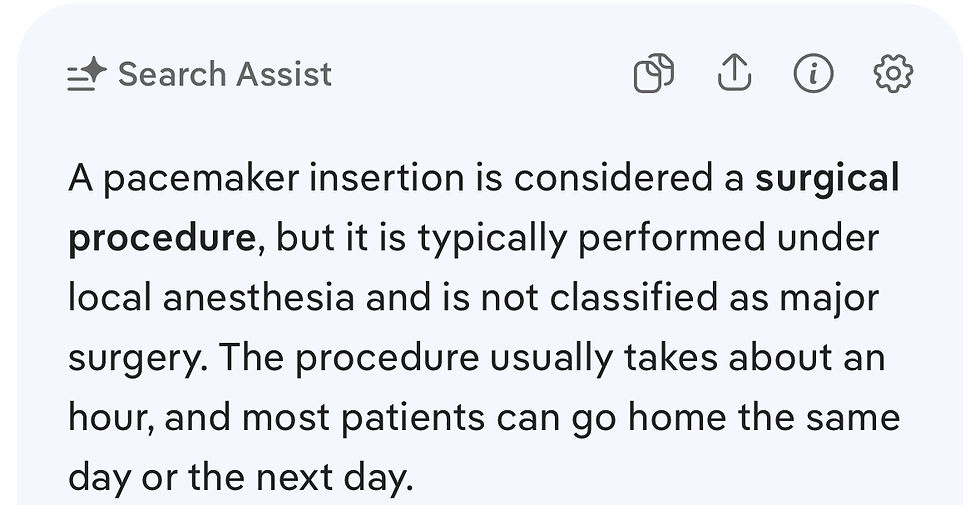
If the hospital documentation confirms an acute-care inpatient stay of at least one day and the leadless pacemaker implantation occurred during that stay, this would support “Yes” for the major-surgery determination.
Active "Major Surgery" for Pacemaker Procedure Requires Other MDS Items to be Answered
If this is the hospital stay immediately preceding the SNF admission, then you are most likely looking at J2100 Recent Surgery Requiring Active SNF Care. J2100 uses the same basic major-surgery criteria but applies to surgery during the inpatient hospital stay 30 days prior to the SNF Part A admission.
Coding J2100 would require a specific active surgery in J2300 to J5000. In this situation, J2700 Cardiopulmonary Surgery - Involving the heart or major blood vessels, open or percutaneous procedures would be coded.
Possible Relevant Aftercare/Status Codes for MDS Item I8000:
Z48.812 — Encounter for surgical aftercare following surgery on the circulatory system
This can apply when the resident is receiving routine postprocedural care following the cardiac procedure.
Z95.0 — Presence of a cardiac pacemaker
This is a status code, not an aftercare code. It can describe that the resident now has a pacemaker without current complications. CMS notes that status codes may be used with appropriate aftercare codes when applicable.
Z45.018 — Encounter for adjustment and management of other part of cardiac pacemaker
This is more specific when the encounter involves management, checking, adjustment, or programming of the pacemaker and would be appropriate only if the documentation indicates actual pacemaker adjustment/management, rather than simply the resident having a newly implanted pacemaker.
In Summary
As usual, a thorough clinical review of the medical records is crucial.
There could be other factors in the documentation that can determine if a procedure is a "major surgery" or not.
Surgical procedure or operative notes should be consistently included in the H&P during transfer to the SNF.
Consider coding other applicable MDS data elements such as those in Section M.
The State RAI Coordinator can be another resource for clarification.
Lastly, refer to the most recent version of the RAI User's Manual for guidance.
Source
1 Centers for Medicare & Medicaid Services Minimum Data Set (MDS) 3.0 Resident Assessment Instrument (RAI) Manual version 1.20.1 effective October 01, 2025
2 Julius Jelisejevas, Alexander Breitenstein, Daniel Hofer, Stephan Winnik, Jan Steffel, Ardan M Saguner, Left femoral venous access for leadless pacemaker implantation: patient characteristics and outcomes, EP Europace, Volume 23, Issue 9, September 2021, Pages 1456–1461, https://doi.org/10.1093/europace/euab083
3 Robert G. Hauser, Charles C. Gornick, Raed H. Abdelhadi, Chuen Y. Tang, Susan A. Casey, Jay D. Sengupta, Major adverse clinical events associated with implantation of a leadless intracardiac pacemaker, Heart Rhythm, Volume 18, Issue 7, 2021, Pages 1132-1139, ISSN 1547-5271,
Disclaimer
This article is meant as informative to reflect current regulations and cannot be considered absolute and universal. The information must be considered in accordance to the individual's organization, state and federal regulations. MDS/RAI Advisor and/or mdsadvisor.org disclaim responsibilty for any adverse effects resulting directly or indirectly from the use of the material, from any undetected errors, and from the user's misunderstanding of the text. MDS/RAI Advisor put forth every effort to ensure that the content, including any policies, recommendations, and sample documents used in these courses are in agreement with current regulations, recommendations, and practices at the time of publication.



Comments